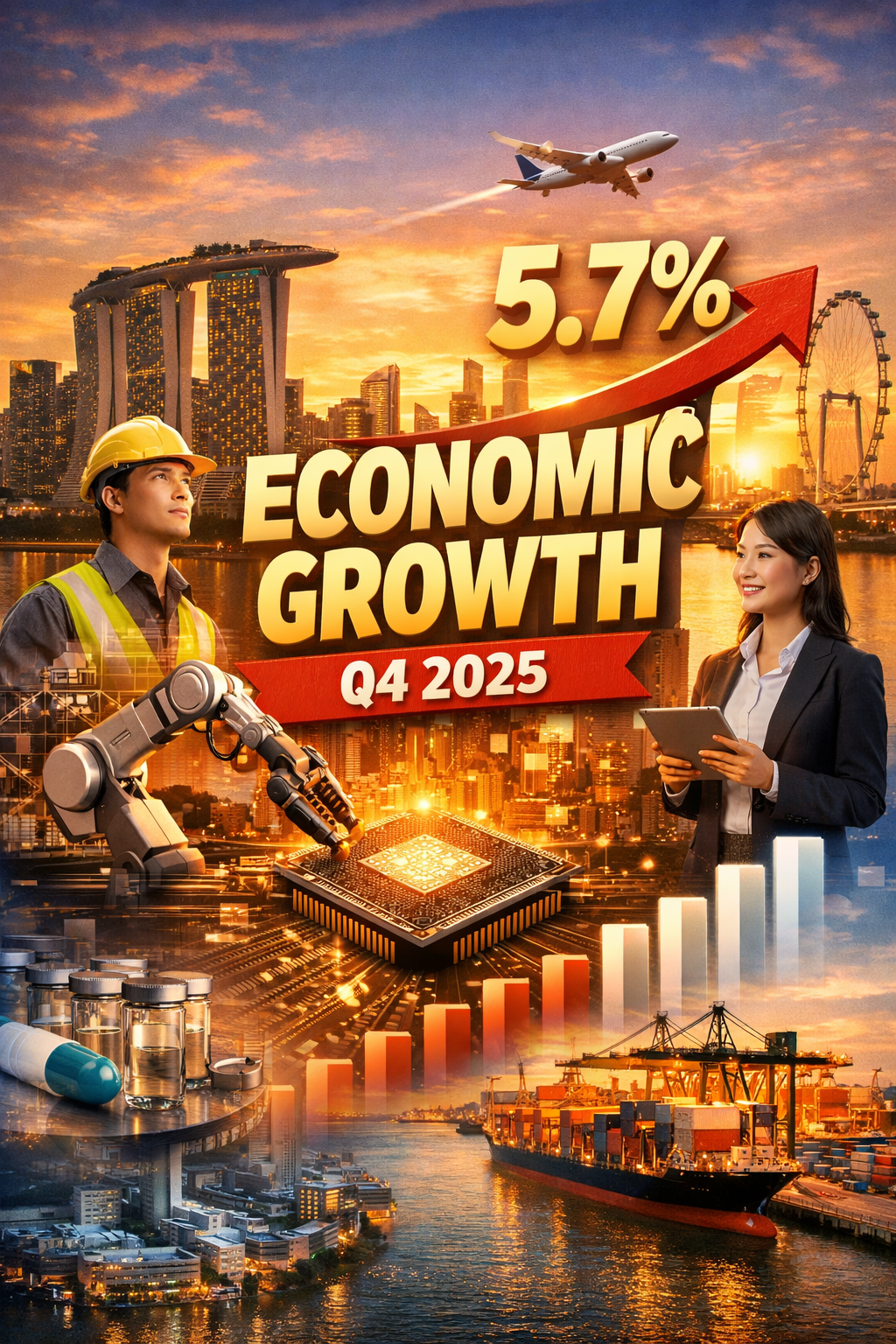
Singapore’s Economy Records Strong 5.7% Growth in Q4 2025 Amid Global Uncertainty
Singapore’s economy delivered a strong performance in the final quarter of 2025, growing by 5.7 per cent year-on-year, according to advance estimates released by the Ministry of Trade and Industry (MTI) on Friday, January 2. This robust expansion marks the fastest quarterly growth recorded in 2025, underscoring Singapore’s resilience amid a challenging global economic environment. The strong GDP growth highlights the city-state’s ability to adapt to structural changes in global trade and technology-driven demand.
The 5.7 per cent GDP growth in Q4 2025 also surpassed the 5.0 per cent expansion recorded in the same quarter of 2024, demonstrating sustained economic momentum. Analysts note that this performance reflects a combination of strong manufacturing output, resilient services activity, and a gradual recovery in construction. Together, these sectors contributed to Singapore’s position as one of Southeast Asia’s best-performing economies in 2025.
Full-Year GDP Growth Reaches 4.8 Per Cent
For the full year of 2025, Singapore’s economy grew by 4.8 per cent, according to MTI’s advance estimates. This figure exceeded expectations and represented a notable improvement compared to the 4.4 per cent growth recorded in 2024. The stronger-than-expected outcome reflects solid domestic fundamentals, stable labor market conditions, and continued inflows of foreign investment into key sectors such as manufacturing, technology, and finance.
Importantly, the 4.8 per cent full-year GDP growth also exceeded the government’s official forecast, which had been upgraded to “around 4 per cent” in November 2025. This upward revision was initially viewed as optimistic, yet Singapore’s economic performance ultimately surpassed even those expectations, reinforcing confidence in the country’s medium-term growth prospects.
Prime Minister Lawrence Wong Highlights Stronger-Than-Expected Growth
Prime Minister Lawrence Wong had earlier revealed the 4.8 per cent full-year growth figure in his New Year’s Day message, describing Singapore’s 2025 economic performance as “stronger-than-expected growth.” His remarks underscored the collective efforts of businesses, workers, and policymakers in navigating a year marked by external shocks and global volatility.
Despite the positive results, PM Wong struck a cautious tone regarding Singapore’s economic outlook. He warned that “sustaining this pace of growth will be challenging,” particularly in a world shaped by fractured trade relations and persistent geopolitical tensions. These challenges, he emphasized, are “not transient problems, but permanent features of a fragmented world.”
Global Headwinds and Economic Caution
The caution expressed by Singapore’s leadership reflects broader global economic realities. Ongoing geopolitical tensions, supply chain realignments, and slowing growth in major economies have created an environment of uncertainty. For a highly open and trade-dependent economy like Singapore, these global headwinds pose significant risks to export demand and investment flows.
According to MTI, economic growth in major economies is expected to slow in 2026, which could moderate demand for exports from Southeast Asia. As a regional trade and financial hub, Singapore remains particularly sensitive to shifts in global trade patterns, interest rate policies, and geopolitical developments.
MTI Forecasts Moderate Growth in 2026
Looking ahead, MTI expects Singapore’s economy to expand by between 1 and 3 per cent in 2026, a significant moderation compared to the strong performance in 2025. This forecast reflects expectations of slower global growth, weaker external demand, and continued uncertainty in international markets.
While the projected growth range suggests a cooling economy, policymakers emphasize that Singapore’s fundamentals remain strong. The government continues to focus on productivity improvements, innovation, and economic diversification to ensure sustainable long-term growth amid evolving global conditions.
Manufacturing Sector Leads Economic Expansion
One of the key drivers of Singapore’s strong economic performance in Q4 2025 was the manufacturing sector, which recorded an impressive 15 per cent year-on-year growth. This marked a sharp acceleration from the 4.9 per cent expansion in the previous quarter, highlighting a powerful rebound in industrial activity.
According to MTI, manufacturing growth was largely driven by robust output expansions in the biomedical manufacturing and electronics clusters. These high-value industries have become central pillars of Singapore’s industrial strategy, benefiting from global demand trends and strong investment support.
Biomedical Manufacturing Boosted by Pharmaceuticals
The biomedical manufacturing sector delivered strong growth during the final quarter of 2025, supported primarily by robust output in the pharmaceuticals segment. Global demand for pharmaceutical products remained resilient, driven by aging populations, increased healthcare spending, and ongoing innovation in drug development.
Singapore’s established position as a global pharmaceutical manufacturing hub has allowed it to capture a significant share of this demand. Investments in advanced manufacturing capabilities, skilled talent, and regulatory excellence have further strengthened the sector’s competitiveness.
Electronics Manufacturing Rides the AI Boom
The electronics cluster also played a crucial role in boosting Singapore’s manufacturing output in Q4 2025. Growth in this sector was bolstered by sustained demand for AI-related semiconductors, servers, and server-related products, reflecting the ongoing global artificial intelligence boom.
As companies worldwide continue to invest heavily in AI infrastructure, Singapore has benefited from its role in the global semiconductor supply chain. The city-state’s focus on advanced manufacturing, research and development, and supply chain reliability has positioned it as a key beneficiary of this structural technology trend.
Construction Sector Records Steady Growth
The construction sector expanded by 4.2 per cent year-on-year in Q4 2025, moderating slightly from the 5.1 per cent growth recorded in the previous quarter. While growth slowed, the sector continued to contribute positively to Singapore’s overall economic performance.
Public sector projects, residential developments, and infrastructure upgrades supported construction activity throughout the year. However, higher costs, labor constraints, and project pipeline normalization contributed to the moderation in growth toward the end of 2025.
Services Sector Shows Broad-Based Expansion
All sectors within Singapore’s services-producing industries recorded growth in the last quarter of 2025, highlighting the broad-based nature of the economic expansion. The services sector remains the largest contributor to Singapore’s GDP, encompassing industries such as finance, trade, transport, and professional services.
This widespread growth reflects strong domestic demand, steady tourism recovery, and Singapore’s continued role as a regional hub for business and finance.
Wholesale Trade Benefits from Strong Electronics Demand
Within the services sector, wholesale trade experienced particularly strong growth, driven by robust sales volumes of electronic components, telecommunications equipment, and computer hardware. MTI attributed this performance to heightened demand linked to the global AI boom.
Singapore’s strategic position as a global trading hub has enabled it to capitalize on increased cross-border trade in high-tech goods. Efficient logistics, strong trade financing capabilities, and trusted regulatory frameworks continue to support the wholesale trade sector’s growth.
Singapore’s Role in the Global Technology Supply Chain
Singapore’s strong economic performance in 2025 underscores its growing importance in the global technology supply chain. From semiconductor manufacturing to AI-related hardware distribution, the country has positioned itself at the intersection of innovation, production, and trade.
Government initiatives to support research and development, attract high-tech investments, and upskill the workforce have played a crucial role in reinforcing this position. As global demand for advanced technologies continues to rise, Singapore is well-placed to capture long-term growth opportunities.
Balancing Growth and Economic Resilience
While the 2025 growth figures are encouraging, policymakers remain focused on balancing short-term expansion with long-term resilience. The emphasis on diversification, sustainability, and innovation reflects Singapore’s proactive approach to economic management.
By strengthening domestic capabilities and reducing vulnerabilities to external shocks, Singapore aims to navigate an increasingly complex global environment while maintaining stable and inclusive growth.
Conclusion: Strong Performance with Cautious Optimism
In conclusion, Singapore’s 5.7 per cent GDP growth in Q4 2025 and 4.8 per cent expansion for the full year represent a strong economic performance that exceeded expectations. Driven by manufacturing strength, services sector resilience, and technology-led demand, the city-state demonstrated remarkable adaptability in a challenging global landscape.
However, with MTI forecasting more moderate growth of 1 to 3 per cent in 2026, Singapore’s leaders remain cautious. As global uncertainties persist, sustaining high growth rates will be challenging. Nevertheless, Singapore’s strong fundamentals, strategic positioning, and forward-looking policies provide a solid foundation for navigating the road ahead.